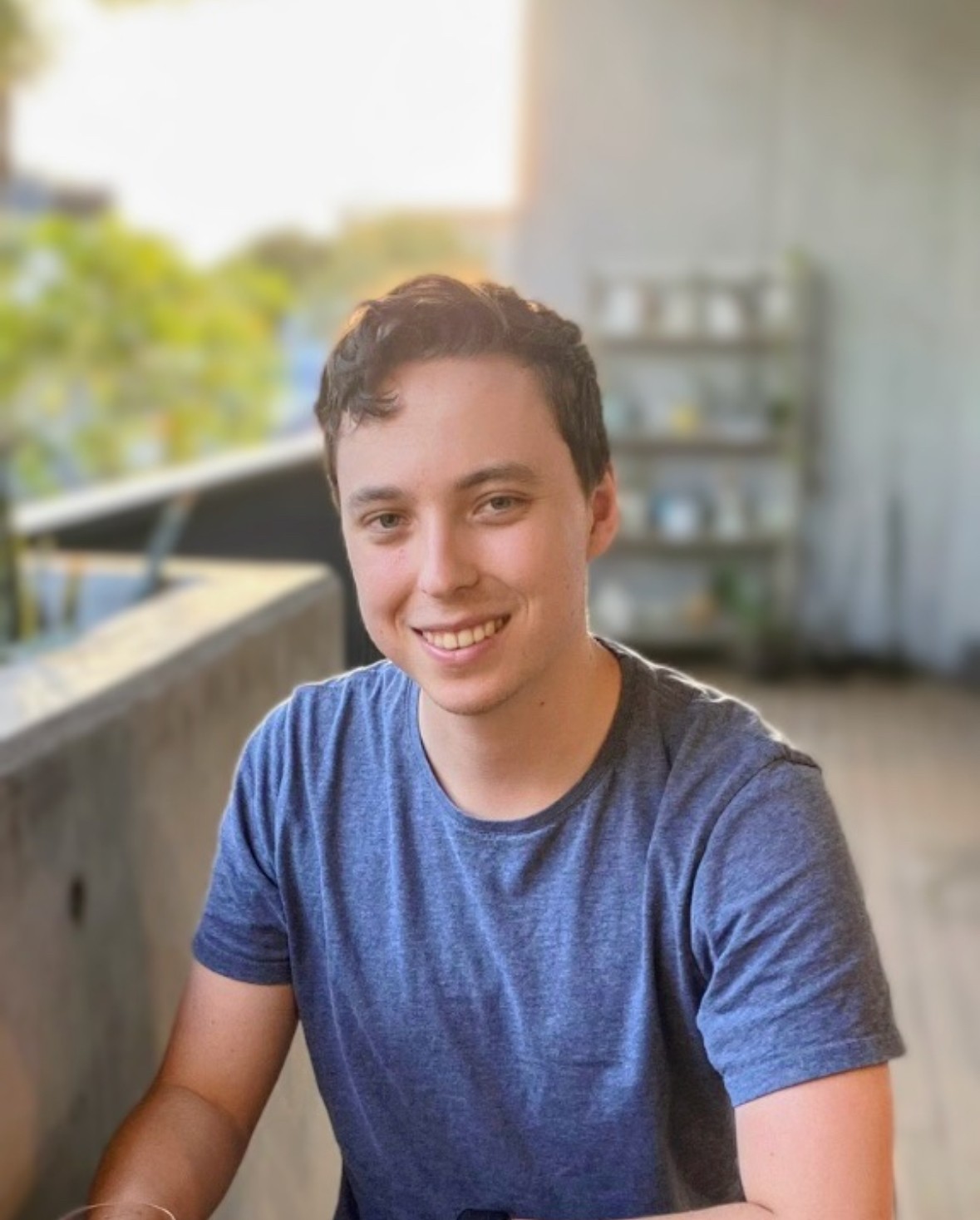
I am Conaire Deagan

I am an astrophysics PhD candidate interested in stellar activity of solar-like stars, photometric anomaly detection with machine learning, exoplanets, and astrophotonic optical physics. I am a member of the NEarby Worlds and Their Stars (NEWTS research group), and a science member on the TOLIMAN project. I am always open to collaboration, email me if you would like to collaborate. Click on the icons on the left to find my BlueSky, Github, LinkedIn, and Email. Find my full email address at the bottom of this page.

I organise and run the UNSW AstroStats Club, where I create educational materials and deliver regular teaching workshops that cover practical applications of Bayesian inference and machine learning technqiues for PhD students and research staff in the School of Physics. See the below link for access to the github repo with all the materials.

Research Interests

Anomaly Detection with Machine Learning

Developing weakly and unsupervised deep learning methods to detect rare and novel phenomena in TESS light curves. I apply representation learning with Bayesian uncertainty quantification to robustly find these anomalies.

Stellar Activity & Surface Mapping

Extending information-theoretic frameworks for reconstructing stellar surfaces with high-precision astrometry. I've demonstrated that this breaks degeneracies in light-curve inversion by accessing complementary spherical harmonic modes that encode hemispheric assymmetries.

Exoplanets

I am interested in the detection and characterisation of Earth-analogues around nearby stars via high-precision astrometry. Working on understanding the astrometric noise environment that these planets exist in, including stellar activity and exozodiacal dust asymmetries.

Bayesian & Information-Theoretic Methods

Application of Bayesian inferences, Fisher information, and maximum entropy principles to astrophysical inverse problems. I run the UNSW astronomy statistics club.

SETI

Just for fun. I have a personal side project looking at isolating animal vocalisations using machine learning with the ultimate goal of classifying these into different meanings.

Latest Publications

Greetings Earthlings Surface Recovery

Inferring hemispheric asymmetries of stellar active regions through the information content of astrometric signals

Deagan, C., et al.

Submitted to MNRAS (2026)

We demonstrate how high-precision astrometry can be used to recover information about stellar surface features that are otherwise unresolved.

Solar Astrometric Jitter by Wavelength

Astrometric exoplanet detection survives solar-like stellar contamination

Deagan, C., et al.

Submitted to MNRAS (2026)

An investigation into the limits of planet detection in the presence of stellar noise, confirming the robustness of future astrometric missions.

Talks

By default, please assume all figures and results in these presentations are unpublished, and thus please don't share them without my permission, unless they also appear in a publication.

Stellar Surface Recovery Using Astrometric Signals: An Information Theory Approach

Presented at MaxEnt 2025

View Slides

Stellar Cartography: Mapping the surface of stars with high precision astrometry

Presented at ASA 2025

View Slides

The surface of unresolved Sun-like stars

Presented at the Stars in Brisbane / Australian Exoplanet Worshop 10, 2024

View Slides

Star-Planet Interactions: How tracking star-spots can give insights into planetary architecture, atmospheric composition, and habitability

Presented at the Australian Centre for Astrobiology Seminar, 2024

View Slides

The place of Astrometry in SETI / High Precision Astrometry: Not just for exoplanets

Presented at Interstellar Frontiers: Bridging SETI, Astrobiology, and the SKA, 2024

View Slides

Star-spots, stellar dynamos and habitable exoplanet astrometry

Presented at Australian Exoplanet Workshop 9, 2023

View Slides

Conference Posters

Cool Stars 22, 2024 Poster

Towards Stellar Obliquities: Recovering Stellar Inclinations via High Precision Astrometric Monitering

Presented at Cool Stars 22, 2024

View Poster
Extreme Solar Systems V, 2024 Poster

Recovering Stellar Inclinatiopn with High Precision Astrometry

Presented at Extreme Solar Systems V, 2024

View Poster
ASA 2023 Poster

Inferring properties of stellar systems via astrometric monitoring

Presented at ASA 2023

View Poster

Internships

In 2025, I completed an internship at the Defence Science and Technology Group (DSTG), applying machine learning to nuclear safety monitoring. I developed a model for event detection, classification, and localisation that outperformed a competing Los Alamos National Laboratory model in two of three metrics and was competitive with it in the third. The work employed Gaussian processes, transformer-based autoencoders, recurrent neural networks, contrastive learning, and saliency mapping techniques.

Teaching Experience

Courses Taught

  • QBUS3600: Business Analytics in Practice (Head Tutor) @ USYD
  • QBUS6600: Data Analytics for Business Capstone (Tutor) @ USYD
  • BUSS6002: Data Science in Business (Tutor) @ USYD
  • PHYS4016: Bayesian Data Inference and Machine Learning (Marker) @ USYD

A challenge

Below is a link to a message. If you can work out what the message says, please contact me. If you correctly work it out, I'll buy you a beer/coffee/chocolate if we ever meet. There are no red herrings or tricks in the message. The message is not encrypted - you don't need to know any cryptography. Good Luck!

Accept Challenge? Post Challenge Survey

Get In Touch

I'm always happy to collaborate on new projects or discuss my research so feel free to reach out. If you are a student of mine, please contact me via official channels. These are likely listed on the Canvas page.